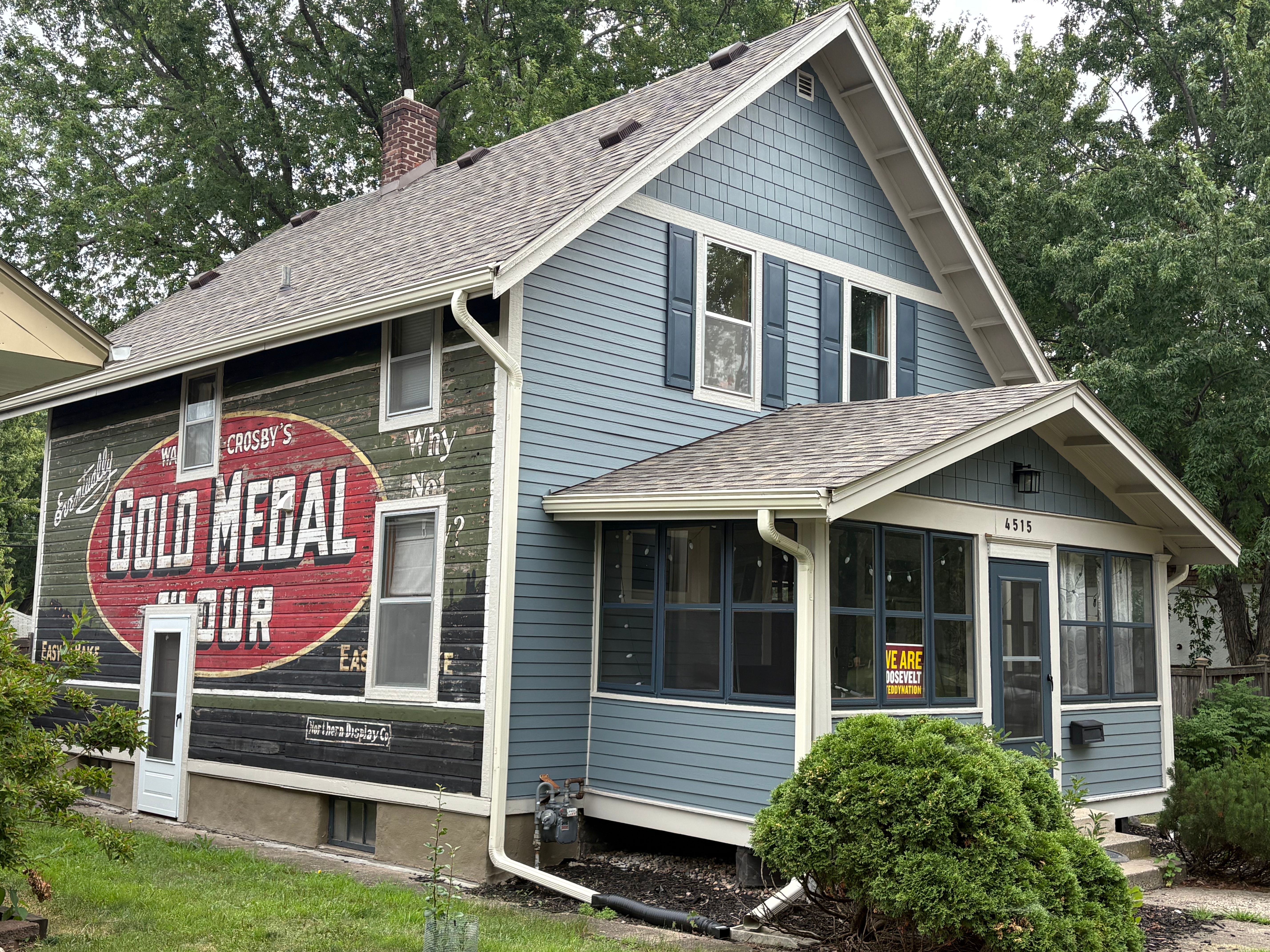
Today I accidentally discovered a Minneapolis landmark that I'd read about a year ago but never visited. There's an otherwise entirely unassuming home in the Longfellow neighborhood of Minneapolis that kind of resists easy classification. It just sort of looks like a home. At least from some vantage points. When interviewed recently by Kare 11, the couple that owned it hesitated to describe it — "What is the style of our house? It doesn't fit any exact style"
But when crews were redoing the siding on both sides of the home, they discovered a giant ad for Gold Medal Flour. The ad on one side of the home is now fully hidden again. But on the opposite side, it's preserved for anyone to see.
The couple was able to remove the ad, intact, and then modernize that side of their home. Then crews carefully replaced it.
As the couple tells Kare 11,
"We re-insulated, modernized the wall, put on new sheeting, waterproofing barrier, drainage plane, and everything, too," George said. "So this essentially then carefully went back up onto the house. They took everything off and numbered it, put it all back up right where it was, and now it's just a decorative screen."
I imagine none of it was easy to preserve. In their report on the home in June, Kare 11 adds that this work required the help of "...several local companies, and financial help from the community and General Mills, which owns Gold Medal Flour."
It would have been much easier to take photos of it, feed the newscycle, and then move on. But landmarks like this make it possible for strangers to have conversations. When I was a kid, I experienced this at Fort Snelling.
---
I used to run around like a tiny, feral storm cloud. My parents were historical re-enactors there, I made friends with all of their coworkers, and more often than not I was allowed to wander unaccompanied inside and outside the confines of the walled fort.
When I met visitors around the grounds, the historic site gave me an opportunity to tell stories to them. I don't know if any of them were all that accurate, because I often role-played as made up individuals. And there's a lot of meaningful discourse about the importance of decolonizing our understanding and our teaching of history.
But just being there, in costume, gave me an opportunity to speak up. Since then, I've repeatedly seen that public or participatory art gives people a very similar window to speak up about their experiences, or to connect more deeply with a neighborhood and its history.
---
The couple that owns the Gold Medal Flour home discovered that at one point the building was a neighborhood store. Which makes a lot of sense for the neighborhood — there's more than one home in the neighborhood that was a store before becoming a residence.
And yet, not a lot of that history is visible in Longfellow.
To revisit Longfellow as it was (neighborhood shops and all), you'd more than likely need to seek out resources like this Google map of Longfellow Corner Stores, created using a 1939 city directory by Paul Strebe and shared via the Old Minneapolis facebook (and publicized by Streets.mn)
In Steele's Map, corner stores litter the streets of Longfellow.
Now, this a little bit of a diversion because there's no landmark for the couple's home in Strebe's map. The closest corner store is Fischer Grocery, at 4461 Minnehaha Ave, just north of the home.
But this isn't the end of their story.
According to a facebook comment written by Allison Suhan Eggers, who is a historic preservationist and "can't help it when a sign this cool pops up near me!" the store actually moved before becoming a residence.
Eggers discovered a building permit for the grocery store that appears to have been filed on October 22nd, 1912 for a business at 4509 Minnehaha, on roughly the same block as the couple's home.
The store was initially owned by the Sorby family who also owned and resided at a home at 1421 Minnehaha (just three lots away, according to Eggers).
As one of the home's owners, George Johnson, recounts his understanding of the lore in a Facebook post, "This was a common way builders would work by acquiring multiple properties building a home, and then living there as they build out the others and move on. One of the sons was listed as a confectioner and possibly had plans to run the store but after a year, the store was sold or leased to August Fillbach."
Eggers also discovered a May 28, 1915 newspaper ad for Chocolate Cream Coffee that lists "August Filbach" at 4509 Minnehaha Ave as a neighborhood supplier of the candy.
Beneath the ad, there are multiple retail grocers listed: including a "August Filbach".
The family wouldn't own the store indefinitely. Filbach "operated it for a couple of years," according to Johnson, until a fire in the summer of 1915. "Did he lose all of his product and go under? How much damage was there? Hard to tell. We do believe he moved back to Wisconsin."
Three residences, including 4509 Minnehaha, are later purchased by a doctor and his family. They reside at 4521 Minnehaha and pull a permit to build a foundation for a home at 4515 Minnehaha where they intend to move the burned store at 4509. That's the Gold Medal Flour home.
This is the part that gets a little bit wibbly-wobbly in my brain. Because the permit to move the store doesn't match the home's current address.
Eggers discovered a moving permit that appears to have been filed on November 4th, 1915 for a business at 4513 Minnehaha. Effectively four numbers away from the store's original address. This doesn't immediately make sense or feel like a smoking gun.
But as Eggers explains, the owner of the store listed on the moving permit is a Mrs. V.E. Hatch. And at this time, 1916 records show a Dr. Melvin A. Hatch living at 4521 Minnehaha Avenue — where the Sorby family also appear to have lived.
Perhaps even more importantly, Eggers notes, "When looking at the Sanborn Maps, it looks like lots on the block got reassigned address numbers, so it makes since that 4513 and 4515 would have some crossover."
(Sanborn Maps, as I've since learned, were published by the Sanborn Map Company in the 19th and 20th century for the specific purpose of underwriting fire insurance policies. Over time, they have become useful for understanding changes such as this.)
This feels like it should be the conclusion of the story. Right?
But somehow, for a house that is otherwise a bit nondescript, it just keeps getting more interesting. This is still the 19th century. Abortion is illegal, and as a result secret operations are not very safe. And when doctors are arrested as a result of botched operations, it causes a significant scandal.
As Johnson tells it, "Seven days after the house was moved to the new foundation, Doctor Hatch was arrested at his office in another part of town and his home was raided by police. It appears he was operating underground abortion services out of [his residence at] 4521."
Hatch goes to prison for manslaughter, and the property at 4515 changes hands multiple times.
This telling of the home's history doesn't even touch on any of the other residents that subsequently followed, or on the story of the billboard on either side of the building, which was erected by the Northern Display Company.
Johnson describes his research on the bilboard company in an October Facebook post, which accompanied this patchwork of clippings.
He also recounted some of the history he learned about the home's last resident in a conversation with MPR.
There's so much history surrounding every decision about the home, and by so many people. As Johnson poetically put it to All Things Considered / MPR News, "I feel like I have all these roommates."
And now that one of the home's billboards is preserved for the whole world to see, all of us can learn about them too.